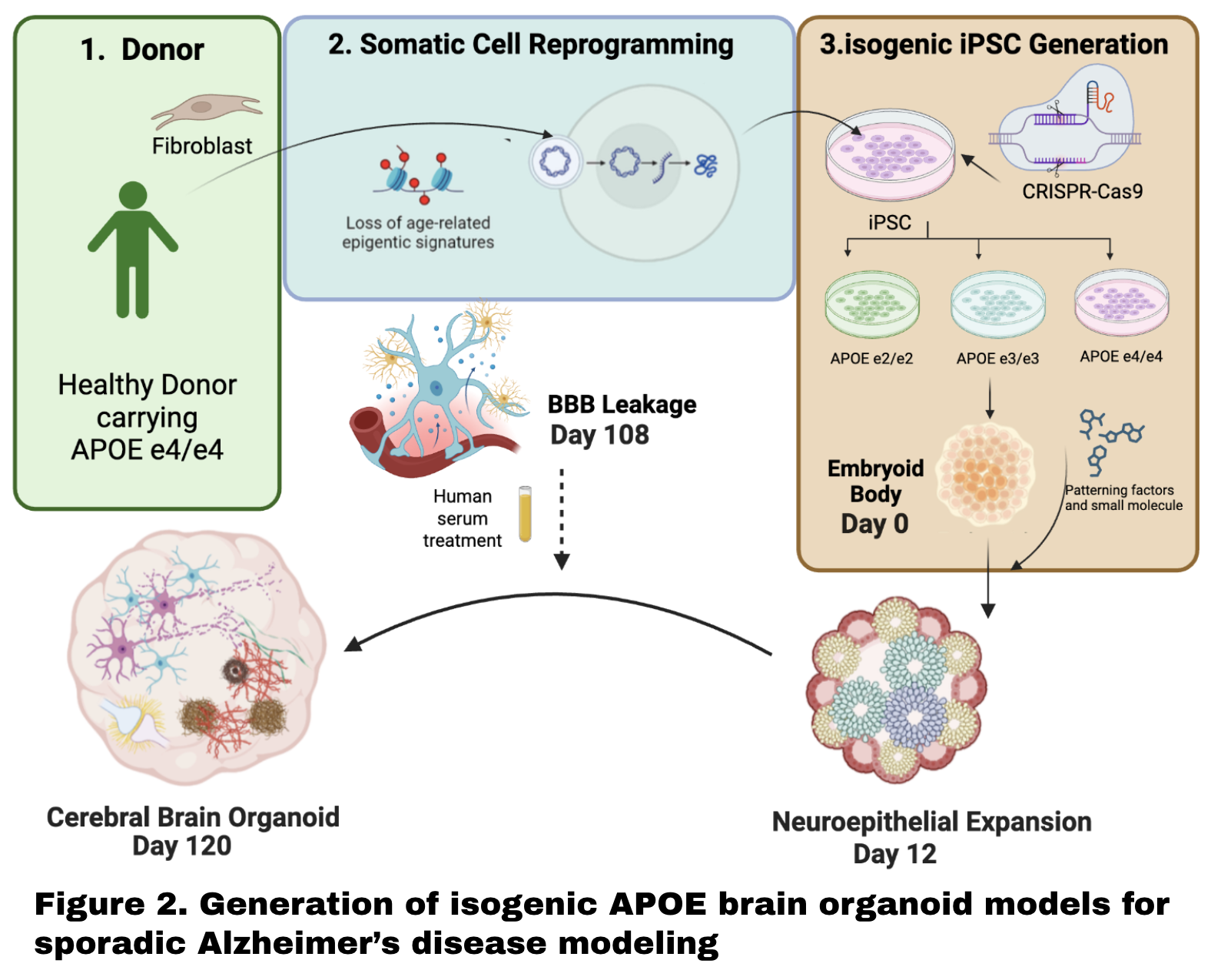
Goal 1 — Isogenic Brain Organoid Generation
Human isogenic iPSC lines carrying APOE ε4/ε4, ε3/ε3, ε2/ε2, and ko/ko genotypes are differentiated through sequential stages — embryoid body formation, neural induction, expansion, neuronal differentiation, and maturation — to produce APOE-genotype-specific brain organoids. Organoid quality is confirmed by structural integrity (ventricular zone formation, cortical plate-like layering, target diameter) and cellular composition (progenitors, neurons, astrocytes).
Goal 2 — Phenotypic Characterization of AD Pathology
Mature organoids are profiled for five AD hallmark phenotypes: Aβ accumulation, tau hyperphosphorylation and neurofibrillary tangle formation, synaptic dysfunction and loss, neuroinflammation, and neurodegeneration. Quantitative molecular profiling is performed via Western blot (Tau, p-Tau, Synaptophysin, PSD-95, Caspase-3, and others) and sandwich ELISA (Aβ40, Aβ42, ApoE). Spatial co-profiling by immunofluorescence and confocal imaging maps the distribution of these markers relative to defined cell-type populations.
Goal 3 — Identification of Pathogenic Molecular Pathways
Transcriptome-wide RNA-seq profiling is used to identify APOE-dependent differentially expressed genes and dysregulated pathways across genotypes. Pathway enrichment analysis maps disease-relevant signaling networks, and key transcriptomic signatures are orthogonally validated by RT-qPCR.